
Mental health in conflict Zones challenges and Solutions in Gaza
⸻
Introduction
By: Aya Al-Mizraawi
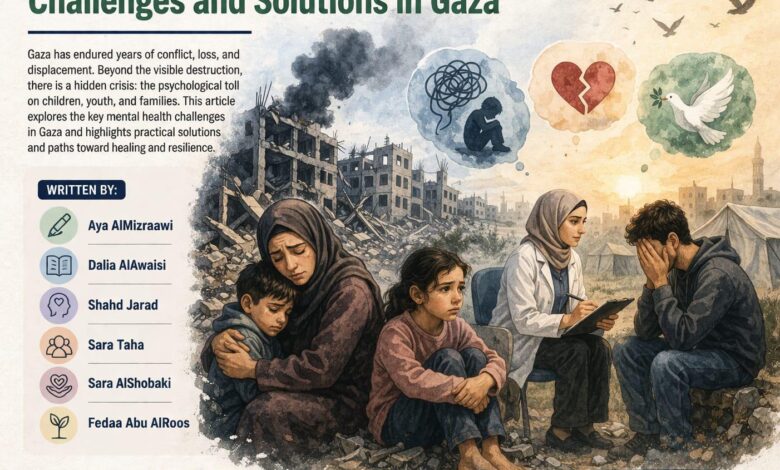
Gaza is not merely a place on the map; it is a deeply human experience shaped by resilience, loss, and survival. In regions marked by prolonged conflict, mental health becomes a silent battlefield where individuals struggle with invisible wounds that often go unnoticed.
The issue of mental health in Gaza goes beyond clinical definitions, touching the core of human dignity, identity, and social cohesion. Years of political instability, economic hardship, and repeated violence have created a complex environment where psychological suffering is deeply embedded in daily life.
This article explores the challenges, impacts, and potential solutions to mental health issues in Gaza, aiming to shed light on a crisis that is often overlooked, yet profoundly affects individuals and communities alike.
⸻
Causes and Challenges
By: Dalia Akram Al-Awaisi
Mental health in Gaza is shaped by multiple overlapping challenges rather than a single cause.
Repeated wars over the years have left deep psychological scars. The impact is not limited to moments of fear during bombardments but extends to long-term conditions such as post-traumatic stress disorder (PTSD).
The loss of loved ones, destruction of homes, and constant exposure to danger have created a persistent state of anticipatory anxiety, where individuals live in continuous fear of future crises.
Additionally, the blockade has contributed to widespread social despair. High unemployment rates, especially among youth and family providers, have led to economic instability and increased family tensions.
The destruction of healthcare infrastructure, shortage of medication, and lack of specialized professionals have made access to psychological support extremely limited. This has also deprived children and youth of safe educational and recreational spaces.
As a result, social structures have weakened, and what is known as “social capital” has begun to erode, placing immense pressure on families—the primary source of emotional support.
Despite all of this, psychological resilience remains present within the community, although it often comes at the cost of deep internal exhaustion.
⸻
Psychological and Social Effects
The psychological impact of conflict in Gaza extends far beyond individual suffering, influencing the entire social fabric.
On an individual level, many people experience chronic anxiety, depression, emotional numbness, and difficulty concentrating. Trauma can alter how individuals perceive safety, trust, and relationships, making daily functioning a challenge.
Socially, these psychological burdens lead to weakened relationships within families and communities. Increased stress often results in conflict within households, reduced communication, and emotional withdrawal.
Communities may also experience collective trauma, where shared suffering becomes part of their identity. While this can sometimes strengthen solidarity, it can also normalize distress and discourage individuals from seeking help.
Moreover, the stigma surrounding mental health remains a barrier, preventing many from accessing the support they need.
⸻
Therapeutic Strategies and Psychological Support
By: Shahd Jarad
In Gaza, psychological support is not a luxury—it is a necessity for survival.
Therapeutic approaches such as individual and group counseling provide safe spaces where individuals can express their emotions without fear or judgment.
Cognitive Behavioral Therapy (CBT) is one of the most effective methods, helping individuals understand and manage negative thoughts and reactions to stress.
Schools and health centers can also play a vital role by becoming spaces of emotional healing, not just education or physical treatment.
Equally important is community-based support. When teachers, volunteers, and community members are trained to recognize signs of distress, they can offer early support and guidance.
True healing occurs when mental health becomes a shared responsibility across society.
⸻
The Role of Institutions and Organizations
By: Sara Taha
In a complex context like Gaza, institutions are not merely service providers but essential pillars of psychological support systems.
Healthcare institutions, NGOs, and community organizations provide structured services such as counseling, therapy sessions, and awareness programs aimed at reducing stigma.
Despite limited resources and continuous crises, these institutions adapt by developing flexible responses to meet growing needs.
They also create safe environments for vulnerable groups, especially children and women, allowing them to express emotions and cope with stress.
However, the effectiveness of these efforts depends heavily on coordination between local and international organizations to ensure sustainability and broader impact.
⸻
Children and Adolescents
By: Sara Al-Shobaki
Children and adolescents are among the most vulnerable groups in conflict zones due to their ongoing psychological and emotional development.
Exposure to violence and instability increases their risk of anxiety, PTSD, depression, and behavioral issues.
Specialized programs are essential to support them, including:
* Educational play activities that help children express emotions indirectly
* Psychological counseling sessions that provide safe emotional outlets
* Creative activities such as drawing, which allow children to communicate feelings they cannot express verbally
These interventions help build resilience, improve coping skills, and support healthy social development.
⸻
Future Challenges
By: Fedaa Mahmoud Abu Al-Roos
Gaza stands at a critical point where future challenges in mental health continue to grow.
A lack of financial resources restricts recovery efforts, while ongoing instability creates uncertainty about the future.
One of the most pressing issues is the fragile mental health infrastructure, which is unable to meet the scale of collective trauma experienced by the population.
The question remains: how can a society heal when it is still exposed to recurring trauma?
Addressing mental health in Gaza requires long-term vision, sustained commitment, and innovative approaches that go beyond emergency responses.
⸻
Recommendations and Practical Solutions
Addressing mental health challenges in Gaza requires comprehensive and sustainable strategies:
1. Integrating Mental Health into Daily Life
Mental health services should be incorporated into schools, healthcare centers, and community spaces to normalize seeking help.
2. Training Community-Based Support Networks
Teachers, volunteers, and local leaders can be trained in psychological first aid to provide immediate support.
3. Expanding Access to Professional Care
Efforts should focus on increasing the number of trained mental health professionals and improving access to services.
4. Promoting Awareness and Reducing Stigma
Public awareness campaigns are essential to change perceptions and encourage individuals to seek help without fear.
5. Supporting Children and Youth Programs
Investing in safe spaces, education, and creative activities helps protect younger generations from long-term psychological harm.
6. Strengthening Institutional Collaboration
Coordination between local and international organizations is necessary to ensure effective and sustainable interventions.
7. Utilizing Art and Creative Expression
Art, music, and storytelling can serve as powerful tools for emotional expression and healing.
Conclusion
Mental health in Gaza is not just a medical issue—it is a human, social, and moral imperative.
Despite immense challenges, the resilience of the people remains a powerful force. With the right strategies, support systems, and long-term commitment, healing is possible.
Gaza is not only a place of suffering—it is also a place of strength, survival, and hope.