Ras Gharib Proposes a New Renewable Energy Model: Rooftop Wind Turbines to Reduce Electricity Bills
By: Ayman Bahr
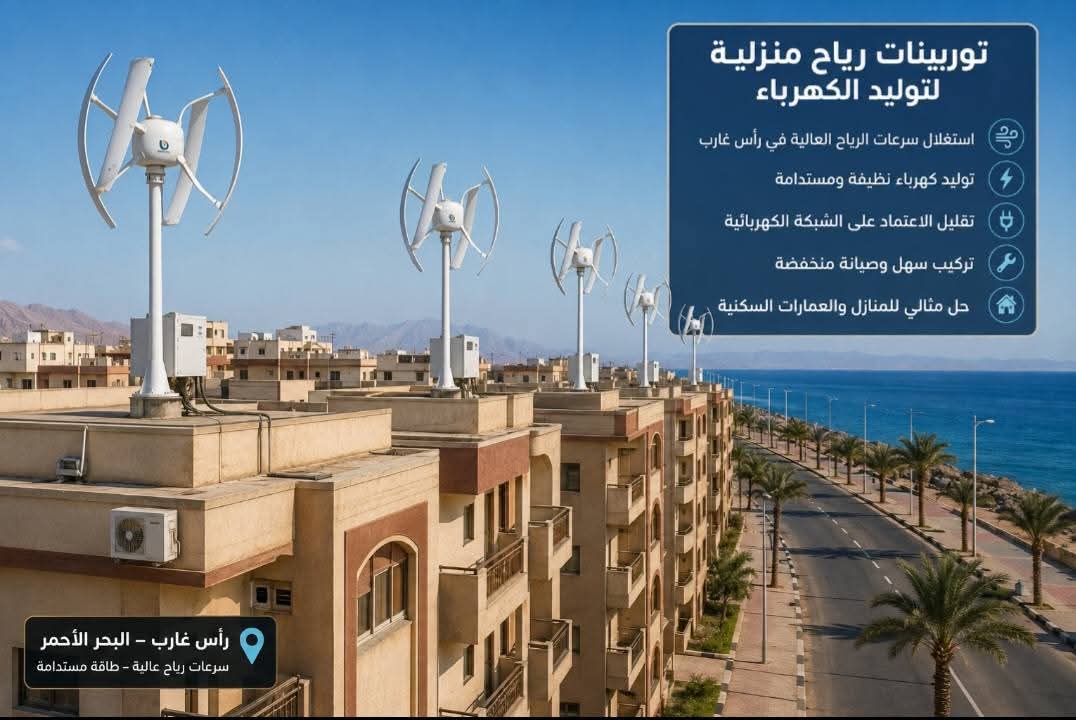
In light of the Egyptian government’s move towards expanding the use of renewable energy and maximizing the utilization of natural resources, an important proposal has emerged for officials and decision-makers: studying the feasibility of installing small residential wind turbines on the rooftops of houses and buildings in Ras Gharib, Red Sea Governorate. This opens the door to a new model for decentralized electricity generation, capitalizing on the city’s promising wind resources.
The idea is based on establishing a small-scale, phased system for generating electricity from wind power near consumption points. This allows residents and businesses to benefit from locally produced energy, thus reducing reliance on electricity drawn from the grid and decreasing energy consumption, as confirmed by technical and economic studies.
Why Ras Gharib?
Ras Gharib’s geographical location makes it a city worthy of serious consideration for this model, especially given the coastal nature of the area and the availability of wind resources suitable for small turbines. Furthermore, the city’s proximity to areas and projects related to the wind energy sector presents an opportunity to leverage accumulated technical expertise in this field and explore the possibility of transforming Ras Gharib into a model for renewable energy applications across residential cities.
From a city that produces energy to a city that participates in its production: The proposal goes beyond simply installing turbines on rooftops. It could begin with a limited pilot project implemented under the supervision of relevant government agencies and in partnership with renewable energy companies.
It is suggested that the project start with a small number of turbines on some schools and government buildings as a pilot phase, while conducting the necessary studies to ensure structural safety, noise levels, the turbines’ impact on buildings and residents, production efficiency, maintenance costs, and the expected economic return.
After evaluating the results, the possibility of gradually expanding to a larger number of facilities can be explored, followed by studying the feasibility of applying the model to homes wishing to participate, in accordance with the technical and legal regulations set by the relevant authorities. “Harness the wind above your home… and reduce your electricity bill.”
If technical and economic studies prove the feasibility of using small turbines in the urban environment of Ras Gharib, the project could represent a new step towards encouraging citizens to participate in producing a portion of their energy needs.
It could also contribute in the future to spreading a culture of clean energy, reducing pressure on electricity grids, and supporting the state’s direction towards increasing reliance on renewable energy sources. This requires a clear system for connecting to the grid and mechanisms for calculating the energy produced, in accordance with regulatory guidelines.
Ras Gharib: An Opportunity Worth Studying
This is not simply a call to install turbines on rooftops, but rather a proposal to study an integrated model for decentralized energy that could begin in Ras Gharib, then be evaluated, developed, and expanded to other areas if it proves successful.
Hence the importance of presenting this proposal to the Ministry of Electricity and Renewable Energy, relevant authorities in new and renewable energy, the governorate, and other relevant state agencies to study the possibility of launching a pilot project in Ras Gharib. The city, historically associated with wind and energy, could become a new Egyptian model, telling the future: “Ras Gharib… from a city of wind power to a city that produces part of its own electricity.”
“Harness the wind above your home… and reduce your electricity bill.”
Most importantly, the idea should begin with a specialized scientific study that identifies the true potential, costs, returns, and safety requirements. A decision should then be made based on the results to ensure maximum benefit from the region’s abundant wind resources.